GROSS (Getting Rid of Stupid Stuff)
Improving Workflows. Supporting Well-Being.
Small frustrations add up.
GROSS (Getting Rid of Stupid Stuff) is a workflow improvement initiative designed to identify and reduce the everyday inefficiencies that impact employees’ work and well-being.
Why It Matters
Workflow friction may feel small, but its impact is not. Unnecessary steps, unclear processes, and communication gaps increase workload, create delays, and contribute to stress, frustration, and burnout.
GROSS gives employees a structured way to identify those barriers and turn them into practical improvements, combining employee voice, collaboration, and shared ownership of solutions.
By removing everyday operational barriers and empowering employees to shape how work gets done, GROSS helps make work easier, more connected, and more sustainable across Emory.
Impact by the Numbers
629
submissions received
407
distinct issues
156
issues resolved
An additional 155 issues are currently in progress. These figures represent seven partner units and 398 team members.
GROSS One-Pager
A one-page introduction to GROSS and how the program works.
Download the GROSS one-pager (PDF)GROSS by the Numbers
Program results to date, including participating units and improvements made.
Download GROSS by the Numbers (PDF)How GROSS Works
GROSS gives employees a direct and structured way to share everyday inefficiencies and collaborate on practical improvements.
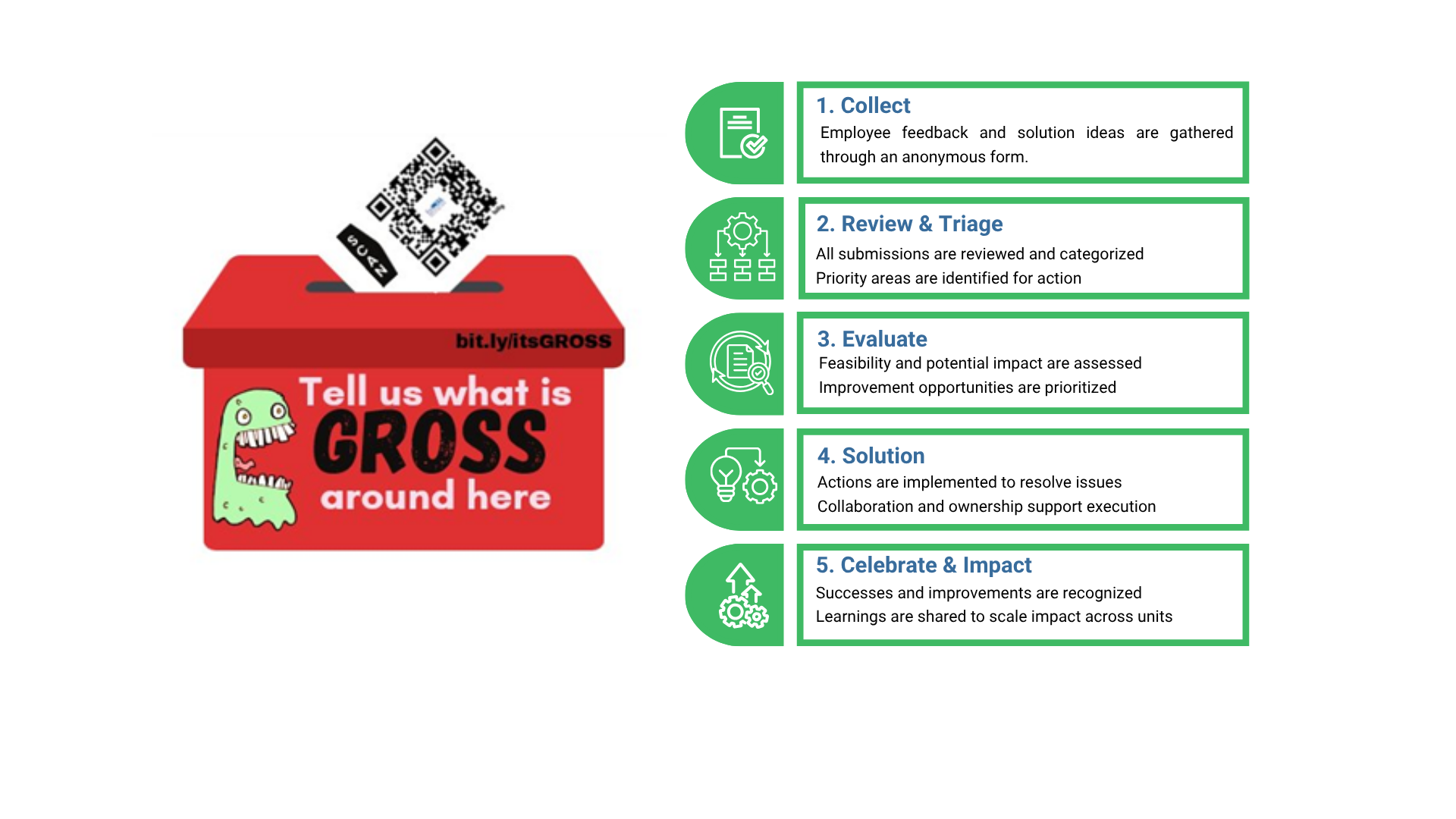
- Collect
Employee feedback and solution ideas are gathered through an anonymous form.
- Review and Triage
Submissions are reviewed and categorized, and priority areas are identified for action.
- Evaluate
Feasibility and potential impact are assessed, and improvement opportunities are prioritized.
- Solution
Actions are implemented to resolve issues, with collaboration and ownership supporting execution.
- Celebrate and Measure Impact
Successes are recognized, and lessons are shared to scale improvements across units.
Impact in Action
GROSS has helped teams turn employee feedback into practical improvements across workflows, safety, communication, and access to resources.

Some improvements implemented through GROSS at Emory include:
- EPIC workflows: 9 workflow updates and 4 system-level improvements
- Supply reorganization: hand hygiene compliance up more than 60%
- Wi-Fi & equipment: fewer lockouts, failures, and supply delays
- Sharps safety & attestations: improved reporting workflow and daily compliance checks
- Gowns, scrubs, & workstations: better OR readiness and easier access
- Intranet, handbook, & pit phone: improved communication and access to information
- Culture Awards: launched to strengthen recognition
- ConsortiEX: stabilized for reliable data flow
- EVS coordination: improved collaboration with clinical teams
Complete the brief interest form. One of the GROSS project leads will contact you to learn more about your goals, answer your questions, and discuss potential next steps.
Questions about GROSS? Email wellbeing@emory.edu.
Background
At Emory, GROSS is grounded in the Nature of Work within the EmWELL Workplace Well-Being Model, recognizing that how work is designed directly affects the employee experience, operational performance, and quality outcomes.
Originally developed at Hawaii Pacific Health and later incorporated into the American Medical Association STEPS Forward™ program, GROSS began as an initiative to reduce unintended burdens for clinicians by encouraging employees to identify inefficient, unnecessary, or poorly designed aspects of their daily EHR and documentation workflows.
The initiative has expanded beyond EHR-related frustrations to address broader operational challenges across the organization, including:
- Operational workflow barriers
- Workforce and communication issues
- Facility and equipment challenges
- Technology and system limitations
- Clinical care process inefficiencies
This broader operational approach positions GROSS as both a workflow-improvement and a workforce-well-being initiative—focused on improving how work is designed, coordinated, and experienced across teams.